
Reviews

First concerts of season for Classics Northwest display sheer talent and mission of music organization
By By Larry Lapidus FOR THE SPOKESMAN-REVIEWSeptember 14, 2026
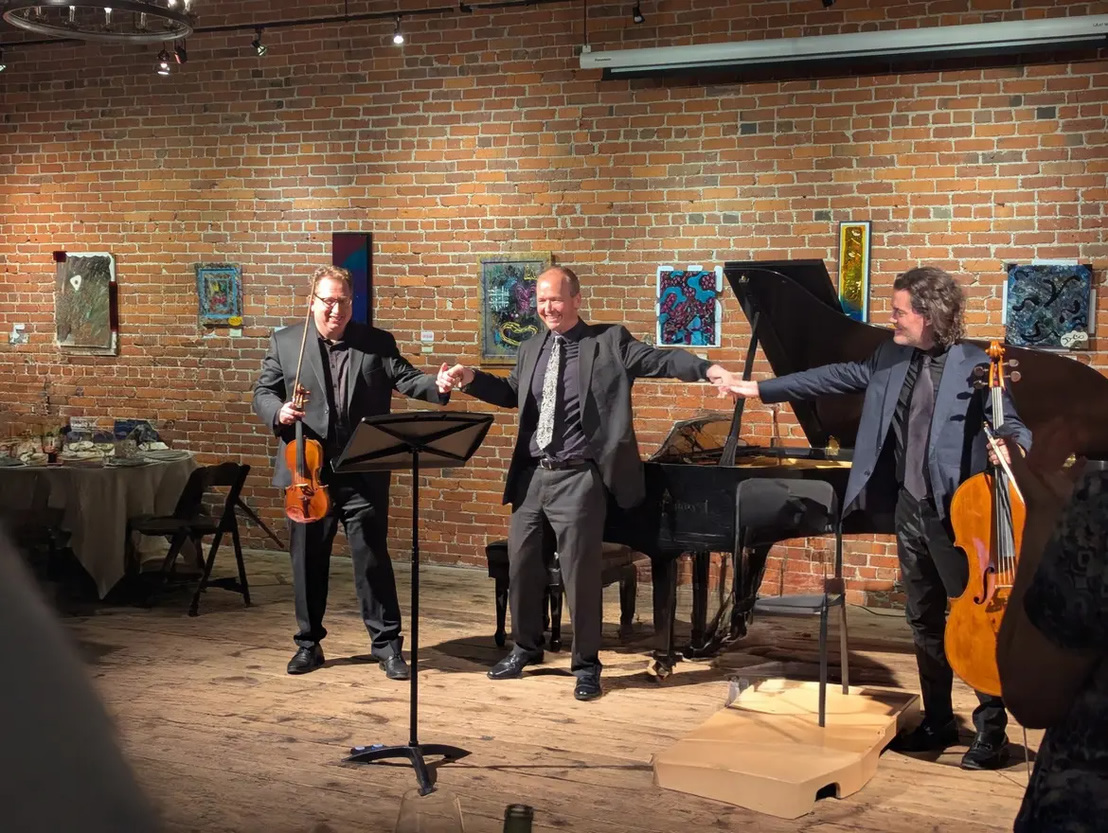
This weekend’s concerts at Barrister Winery by Classics Northwest – the first of their 2026-27 season – offered plenty of beautiful and exciting music, but that was not all. Also on display was the fully formed vision of Artistic Director Zuill Bailey of how Spokane’s yearlong music festival will respond to the radical changes that have taken place over the 10 years that have passed since Bailey assumed leadership of Northwest BachFest. These changes have included the collapse of the recording industry, which has mightily impacted the means by which any professional musician can earn a living, and the emergence of new styles and sources of music composed for performance in a concert setting.
One fundamental element in the future of ClassicsNW is the element of collaboration. Just consider the range of performers in these two concerts. To begin with, there is Bailey himself, not only a brilliant musician of international celebrity, but an arts administrator with decades of experience. Saturday’s concert featured Yuri Bekker, violin, artistic director and concertmaster of the Charleston Symphony Orchestra, and Domonic Dousa, piano, a distinguished composer and music professor and colleague of Bailey’s on the faculty at the University of Texas at El Paso.
To stretch this collaborative web further, these three outstanding musicians were joined on Sunday afternoon by a quartet made up of the principal players in four of the string sections of the Spokane Symphony: Mateusz Wolski, concertmaster; Amanda Howard-Phillips, second violin; Nick Carper, viola; and Alan Ohkubo, interim principal of the cello section.
At the pinnacle of this pyramid of collaboration was the world premier performance on Sunday of the chamber music version of a new work that features the cello, commissioned jointly by Classics Northwest, the Spokane Symphony, the Cincinnati Chamber Orchestra and the Long Beach Symphony, in observance of the 250th anniversary of our country’s founding. The piece is fittingly entitled “Visions of Humanity and Unity for America 250,” and might best be described as a suite in five movements. As you can see in the program box, the movements are contributed by American composers of diverse backgrounds: African American, Israeli, Chinese, Mexican and Irish, thus mirroring the diversity of our culture. It is important especially for Spokane readers to realize that another figure originated the idea of a collaborative commission, and guided it to fruition: Eckart Preu, for 15 years conductor and music director of the Spokane Symphony, and current conductor of both the Cincinnati Chamber Orchestra and Long Beach Symphony. Long a citizen of the U.S., Preu was born and received his foundational training in East Germany.
After collaboration and diversity, the third dimension in which ClassicsNW will henceforth be operating, and which was most apparent at these concerts, is choice of repertoire. Bailey made it clear that the narrow confinement of the festival to the works of J.S. Bach was a thing of the past. Longtime observers of the festival have watched as one barrier after another has fallen that once would have this composer or that instrument or style of performance to be unsuitable for inclusion on a NW BachFest program. Now, it’s official; with the change of name to ClassicsNW, Duke Ellington’s deathless bit of wisdom has in effect been engraved above the door: “If it sounds good, it is good.”
And what we heard in both concerts did indeed sound good, beginning first with Vaughan Williams’ “The Lark Ascending” and Domonic Dousa’s delicate evocation of dawn in the English countryside, followed by a thin stream of rapturous tone from Yuri Bekker’s Guarneri violin, a stream that grew into an ecstatic flood that raised the blood pressure of everyone in the room. Every measure we heard from this artist was distinguished by beauty of tone, interpretive insight and acute sensitivity to the contributions of his colleagues. Listening to an artist of this calibre leaves one somehow feeling not only satisfied artistically, but morally elevated.
As moving as his solo performances were in the pieces by Vaughan Williams, Korngold and Copland, his collaborations with Bailey were in a way even more remarkable. In the Brahms “Double” concerto, he and Bailey matched each other’s tone and expression – a feat which Brahms plainly demands in the perfect symmetry of his composition – to a degree equaled to these ears only in the 1939 recording of the work by Jascha Heifetz and Emmanuel Feuermann. The combination of spontaneity, discipline and inspiration we heard in their rendition of the Mozart Duo was the sort of miracle for which music lovers always hope, but seldom experience.
In his remarks to the audience, Bailey emphasized the fact that he and his colleagues were able to perform the Elgar and Brahms concertos for us only because they used versions in which the dense orchestral parts had been reduced to the two staves of a piano score. Such reductions were common throughout the 19th and early 20th centuries, as they allowed soloists to tour smaller towns where there were no symphony orchestras, presenting their interpretations to audiences who would otherwise never be able to hear them. This practice declined with the spread of radio and phonograph records, but Bailey feels that reinvigorating it is an essential part of a solution to the threat to live music posed by Spotify and YouTube.
These versions are challenging for the pianist, and often awkwardly written for the keyboard. Domonic Dousa’s renditions were not note-perfect, but the occasional fudged mordent or imperfect scale passage was rendered insignificant by the unvarying musicality with which he balanced his tone quality and expression to those of his colleagues and to the demands of the composer. In the performance of “Vision of Humanity and Unity” – a score with which he was intimately familiar, having served not only as performer, but as consultant in its composition – his contribution was flawless. More than flawless, his ability to negotiate the complex and irregular rhythms, or to surround Chandra Dancy’s sinuous melodies with a steamy, sensuous haze was simply astonishing.
A final estimate of “Vision,” the chamber music version of which received its world premier on Sunday afternoon, must wait until we have had a chance to hear it in its full orchestral garb, performed this coming weekend as part of the opening concerts of the 81st season of the Spokane Symphony. It is hard to imagine, however, how that performance could provide greater pleasure, so engaging were the melodies, so compelling the rhythms, so polished and inventive the composition, and so vital and committed the performance we enjoyed. Especially considering that the availability of a chamber music version will make it available for presentation by colleges and community ensembles throughout the country, one can easily see the life of this exciting new work extending far into the future. It was for this reason that, as a requirement for him to participate in the commission that all five composers agree to submit scores for both full orchestra and chamber ensemble.
As to Bailey’s role as a performer in these concerts, it may seem pointless to provide further comment on an artist who, after more than 10 years, is a well-known commodity to Spokane audiences. So it would be, were his playing simply stable, reliable and uniform year after year. But it is not, nor would this ever be the case for any truly unique and outstanding artist, whether it be in music or tennis or costume design. Great artists are always surprising, always unpredictable, always growing. Bailey made an extremely fine recording of the Elgar Cello Concerto in 2012, so fine, in fact, that it has been declared the reference recording by several distinguished critics. Still, the cellist on that recording sounds like a student of the man who performed that piece on Saturday, so much greater was the technical command and interpretive assurance displayed by the contemporary than the historical Bailey. Whether as a soloist or in an ensemble, Bailey is always collaborating … with the audience, sensing as with some third eye or ear just what his listener needs from the next note or next phrase, and then delivering it. One never tires from listening to artistry at this level.
Concert review: Rich musical tradition on show with Greg Presley, Zuill Bailey show followed by Time for Three
By By Larry Lapidus FOR THE SPOKESMAN-REVIEWJuly 24, 2026
The Listening Room at Hamilton Studios was the site of Tuesday night’s presentation by Classics NW. In keeping with the spirit of enterprise and innovation that has increasingly characterized his programming, Music Director Zuill Bailey brought together styles and traditions that in times not long past would not have appeared in the same room, much less on the same program. The concert fell into two segments: in the first, Bailey, in his role as one of the world’s leading cellists, partnered with pianist Greg Presley in performing series of works of dazzling variety by Robert Schumann, Ludwig van Beethoven, Frederic Chopin, Lucas Foss, Claude Debussy, Piotr Tchaikovsky and Nicolo Paganini. In the second segment, the stage was stormed by Time For Three, a high-voltage string trio made up of violinists Nick Kendall and Charles Yang and bassist Ranaan Meyer. Much of what they played and sang was improvised on the spot, some was based on compositions by members of the group or by contemporary composers, but none of it appeared on its surface to have anything whatever to do with the retinue that produced the music of the first segment.
Still, the alert listener – and the room was, as usual, filled with alert listeners – could not help but feel as they left the building that what they had heard was in some way bound together by a cohesive and uniform spirit. If one were to search for a single embodiment of that spirit, it would have to be Bailey, himself, who opened the program by playing an arrangement of “Traumerei” from Schumann’s piano suite, “Kinderszenen,” or “Scenes from Childhood.” That performance, Bailey announced, was in memory of Charles Karschney, who played for over 40 years in the horn section of the Spokane Symphony, as well as serving as the orchestra’s production manager. Bailey’s performance of the “Traumerei” was what every pianist wishes to achieve at the keyboard, but never can. The seamless passage from one note to another, the subtle variations of volume within a single note, the execution of a real crescendo or decrescendo – all of the ways in which a bowed instrument like a cello can reproduce the affect of the human voice – are beyond the capability of a piano, which, for all its fancy mechanism is a percussion instrument.
From its first notes, Bailey’s rendition of “Traumerei” was filled with exactly the tender mixture of sorrow and sweetness, of fear and anticipation that Schumann meant to evoke in his portrayal of a child just going to sleep, and that Bailey meant to convey in contemplating the passing of a valued friend and colleague. Some members of the audience no doubt recalled earlier concerts which began with Bailey’s conveying to the audience some incident of profound personal impact – the death of his teacher, Joel Krosnick, for example, or his own experience of depression during the COVID shutdown. Such intimate confessions are not unrelated to his unique identity as an artist and an arts administrator. They all speak of a personality that seeks to bond with other people, and draws pleasure from helping such bonds form between others. To an artist like Bailey, communication is not merely a useful skill, it is a compulsion.
The effect of this trait was nowhere more evident than in Bailey and Presley’s rendition of the Cello Sonata of Claude Debussy (1917). The work was written three years before the composer’s death and is considered representative of his “late style,” which is less linked to sensory impressions than are such earlier works as “Claire de Lune” (1890) and “Prelude to the Afternoon of a Faun” (1894). The view of the Debussy Sonata as an objective manipulation of harmonies and performance techniques designed to produce a series of effects on the listener plainly does not appeal to Bailey, who preceded his performance of the piece by describing a detailed dramatic scenario which he said Debussy had in mind when he composed the piece, but did not want revealed to the public. The scenario involved Pierrot, the tragi-comic fixture of commedia dell’arte, who, while at a park, spies a lovely girl from afar, characteristically falls madly in love with her, and uncharacteristically ends by feeling buoyed by hope.
After so setting the scene, Bailey and Presley proceeded to deliver a reading of the Debussy Sonata in which virtually every phrase was redolent of emotion, and in which every passage seemed to advance a narrative. It was as far from dry-eyed objectivity as one could get, and quite unlike any performance of the work in this listener’s experience. As different from one another as the other works were that Bailey performed, they all had in common the palpable intention to bond with the audience and to produce a powerful positive response, very often reinforced by spoken remarks by the artist. We cannot say why, but some artists have the ability to reach down to the core of our emotions and enhance our awareness of what matters most in life. Maria Callas is in that class; so is Arthur Rubinstein. So is Bailey.
And so, when Time For Three took the stage with their no-holds-barred assault on any assumptions the audience may have held about stylistic appropriateness or separation of genres, the scene had been set. The name of this music festival had been changed from NW BachFest to Classics NW for a reason: not only to remove the specific tie to the music of Bach, but to enlarge the scope of what could be presented to include virtually every type of music, provided only that it be “classic,” that is, of the very highest quality, of a standard that bears comparison with the finest to be found in any land during any period of history.
The members of TF3, as they are also known, surely meet that criterion. All are masters of their instrument, having been trained at the country’s finest institutions by celebrated teachers and mentors. As a group, they are determined to resist stylistic pigeon-holing, employing classical technique in the performance of a blend of rock, jazz and country/folk. They are Grammy winners, who have made albums with none less than Metropolitan Opera star Joyce DiDonato. For all their explosive energy and intensity, there are no notes off pitch, no ill-tuned harmonies or sloppy entrances. Everything they do is assured, disciplined and purposeful, without ever betraying a hint of routine. As one would expect, such commitment – the trio has been together for over 20 years – springs from a deep belief in the essential moral importance of art. This has led them to found and operate educational collaboratives, administer grant programs and make over 2,000 visits to schools.
Thus, their presence on the program with Bailey and Presley, as different as Beethoven and Schumann appear to be from Leonard Cohen or numbers called “My Shot” or “Vertigo,” ended up making both rational and aesthetic sense. Everything we heard asserted the present value of the rich musical tradition we have inherited, and the crucial need not only to preserve, but to further the hopes and aspirations of the artists who have created it.
Classics NW ends its first season with musical exploration of beauty
By By Larry Lapidus FOR THE SPOKESMAN-REVIEWMay 18, 2026
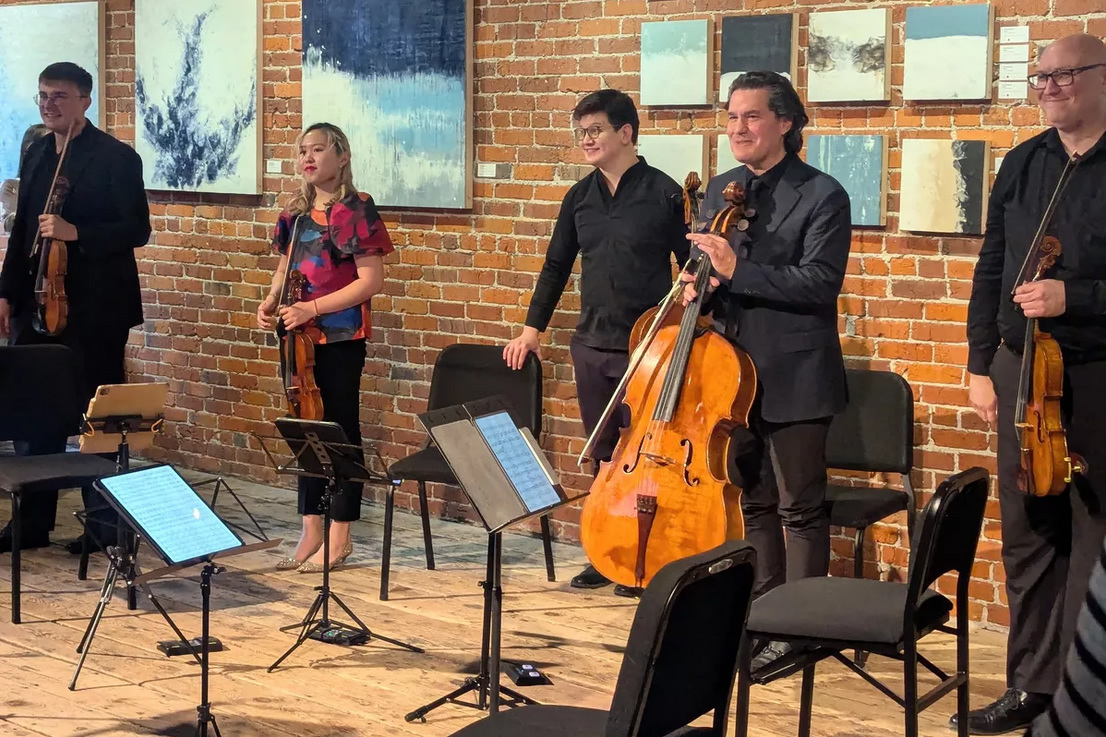
Perhaps it was the awareness that change was in the air. After decades of operating as the Northwest Bach Festival, Spokane’s year-round music festival was undergoing a change, both of name and as substance, to Classics Northwest, under its Music Director Zuill Bailey. Perhaps it was the appearance of Nick Carper, principal viola of the Spokane Symphony, who is admired by a cadre of followers. It cannot be denied, though, that the principal cause of the joyous and celebratory mood that permeated the weekend’s two final concerts in the 2025-26 season of Classics NW was the love of music that radiated from the Balourdet String Quartet, making its second appearance in Spokane. Its membership is happily unchanged: Angela Bae and Justin DeFilippis, violins, Benjamin Zannoni, viola and Russell Houston, cello.
The group’s two concerts in April of last year were characterized as much by their intense projection of emotion as by their mastery of all the technical, instrumental resources available to a string quartet at the very peak of its profession. One can report that both the emotional impact and virtuosic capability of the quartet are undiminished. If possible, they have only gained in their symbiotic ability to elevate an audience from where they sit to a higher plateau, from which they can view beauties of life which have become obscured by the ceaseless demands of the clock.
Both Saturday’s and Sunday’s programs, though diverse in the styles and periods from which they drew, were made up of music from the same categories: 1. String Quartets by Female Composers; 2. 19th century works for String Quartet; 3. String Sextets. In the first category were the String Quartet No. 2 (1994) by Eleanor Alberga (1949-) and the String Quartet in One Movement (1929) by Amy Beach (1867-1944). In the second category were the “Andante Cantabile” for cello and string quartet (1871) by Tchaikovsky, the second movement of Brahms’ String Quartet No. 3 in B-flat Op. 67 (1875), and Beethoven’s String Quartet No. 11 in F minor Op. 95 (1810).
To perform the string sextets, the Balourdet Quartet was augmented by the viola of Carper and the cello of Bailey. On Saturday audience member heard the glorious Sextet No. 1 in B-flat Op. 18 of Brahms (1860) and on Sunday, Tchaikovsky’s Sextet “Souvenir of Florence” in D minor Op. 70 (1890). Binding together such a varied and substantial program was the passionate commitment by the Balourdet Quartet and their colleagues to making every member of the audience feel as intensely as they do.
The sense of discovery was perhaps most evident in the quartets by Beach and Alberga. Beach was a pioneer not only in establishing a flourishing career as a woman in the male-dominated classical music establishment, but also as a visionary composer, open to the most advanced and enterprising trends in the music of her time.
Her only string quartet is brief but concentrated. It begins with a highly chromatic introduction of uncertain tonality, which is finally stabilized by the appearance of themes taken from the music of the Inuit. The power, simplicity and directness of indigenous cultures fuse with European techniques of musical development to create a vigorous and compelling central section, which is rounded off by a return of the meditative, questioning material of the opening section.
Alberga’s String Quartet No. 2 is plainly composed by a master of the most far-reaching and sophisticated techniques to have developed in the 65 years that followed the publication of Beach’s quartet. Alberga, a native of Jamaica, has long resided in England, where she has led a tremendously productive career as a composer, teacher and performer. It is plain from the performance of her second quartet that Alberga has immersed herself deeply in the quartets of Béla Bartok. She has not only achieved the technical mastery but also a degree of intellectual and spiritual integrity that stands comparison with those of the Hungarian master.
The Balourdet Quartet not only proved equal to Alberga’s extremely demanding string writing in the quartet, they – to borrow a phrase Rachmaninoff’s – “swallowed it whole.” The slashing bow strokes, complex polyrhythms, vertiginous passages at the upper extremities of the fingerboard, all were executed flawlessly, and never drew attention away from the rigorous exploration of the ideas and emotions which provided the music’s true reason for being.
To turn to the second category, Tchaikovsky’s “Andante Cantabile” was a star-turn for Bailey, who played Tchaikovsky’s gently melancholy themes with exquisite care, imbuing them with just the right balance of sentiment and stoicism. It was a great pleasure to hear him play out like the great soloist he is, with such full-throated ease – a degree of license in which he cannot take when striving to integrate himself into an ensemble.
This requires a greater degree of expressive modesty, as we saw when Bailey and Carper (who is a noted string stylist himself) joined the Balourdet Quartet in performing the two culminating works of the weekend’s concerts: the sextets of Brahms and Tchaikovsky. By programming these two blockbuster works, Bailey wanted to celebrate all that had been accomplished by the Northwest Bach Festival, while also creating a feeling of excitement and for what lay ahead for Classics NW: an even broader range of repertoire, embracing not only classics from the Classical tradition, but classics of other traditions, as well - folk, rock, musical theater – all music that is sufficiently well made, sincere and authentic to stand the test of time, “providing,” as Bailey said, “something for everyone in the region, while furthering our priority of making music accessible through education and community engagement.”
Both sextets are rich enough in melody and sonority to give tremendous pleasure and to create just the type of excitement Bailey intended. It is likely, however, that for many, the Brahms sextet fulfilled that goal more completely than did Tchaikovsky’s “Souvenir.” Tchaikovsky’s work is awash in gorgeous melody and infectious rhythm, but the Brahms sextet is the better-written piece. While Tchaikovsky pads the spaces separating one amazing melody from the next with repetitive sequences and formulaic modulations, Brahms employs his genius for development in constantly searching after and finding new beauties in every fragment of melody, and exploring endlessly the effects of combining one instrument with another. Brahms’ inspiration does not start and stop, but remains continuously active over long spans. This sort of integrity is experienced by an audience as taking a continuous journey of exploration and discovery, all the while ascending a steady incline of emotional involvement. The culmination of that journey was made audible on Saturday night with an explosion of applause at Barrister Winery that must have been audible in Ritzville.
Technique and virtuosity on display at Classics Northwest concert featuring pianist Piers Lane
By By Larry Lapidus FOR THE SPOKESMAN-REVIEWMarch 10, 2026
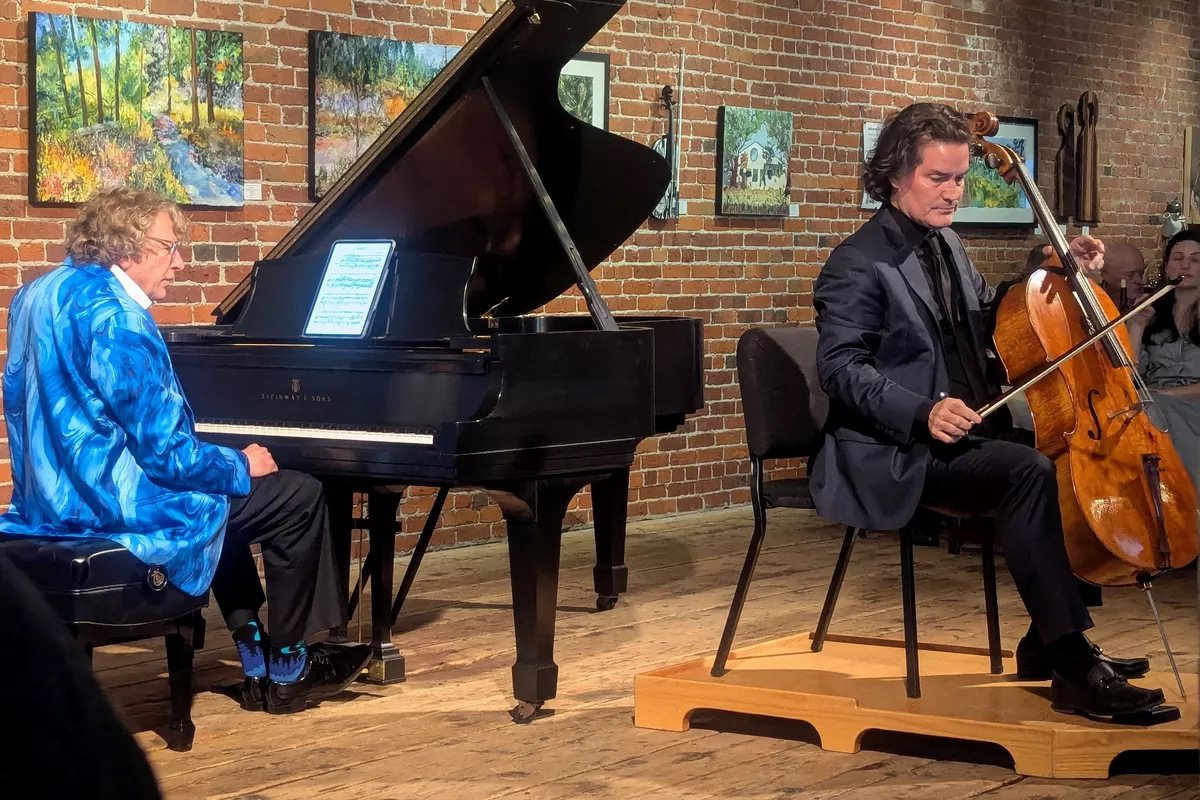
Like a springtime Santa, Zuill Bailey blew into town over the weekend, bringing with him his customary bag of gifts: irrepressible energy, a tireless pursuit of excellence and an abiding belief in the power of music to enhance our lives. Also as customary, he was accompanied by a member of his worldwide network of colleagues exhibiting the same traits. This time, it was the Australian pianist, Piers Lane, who last appeared under Bailey’s aegis nine years ago. At that time, he guided us through a tour of European music beginning with the crystalline clarity of Mozart and ending in the demented supervirtuosity of Leopold Godowsky.
This time, a program of a pair of recitals at Barrister Winery, featuring both Bailey and Lane, was much more narrowly focused on music of the Romantic era. Last week’s concert by the Spokane Symphony featured works by three composers of the Romantic era: Robert Schumann, his wife Clara and the other man who loved Clara, Johannes Brahms. Zuill Bailey obligingly filled in the mural of this era of musical history by programming works of Franz Schubert (1797-1828), Felix Mendelssohn (1809-47) and Frederic Chopin (1810-49). Even for us, living in a period of rapid progress, it is remarkable to consider that all of the masterpieces performed on Saturday and Sunday were composed between 1825 and 1847.
Both concerts were divided into two sections, with the first consisting of solo works performed by Lane, who was joined after an intermission by Bailey to perform works for cello and piano. Saturday’s solo program was dedicated to works by Schubert: his Impromptu in G-flat major D. 899 and his Piano Sonata in D major D. 850 those numbers preceded by a “D” specify where the work can be found in a catalogue of Schubert’s works compiled by Otto Deutsch). From the opening measure of the Impromptu, the luminous tone produced by Lane assured everyone present that the treasured repertoire they were about to hear would come to them from the hands of a master. While singing out Schubert’s serene and sad melody Lane maintained the accompanying arpeggios both at a lower volume and softer touch. When Schubert’s tone darkened to suggest the tragic underpinnings of earthly happiness – a distinctive feature of all of Schubert’s late works – Lane managed to increase the volume of the music while maintaining the suffused, non-percussive quality of the tone.
In the D major Sonata that followed, the range of Schubert’s expression greatly increased, and with it our awareness of Lane’s skill. At one point in the second movement, for example, where Schubert asks the pianist to alternate the melody between the two hands, Lane altered the tone quality between the hands to preserve the balance between melody and accompaniment. While piano mavens might wonder at the technique required to render Schubert’s argument with such clarity and consistency, the average attentive listener heard no technique at all; only music that seemed to spring from the piano as freely and spontaneously as it did from the composer’s uniquely gifted mind and heart.
As Saturday’s program progressed, Lane’s remarkable ability to convey the essential voice of the composer, rather than drawing attention to the charm, wit and sensitivity of his own personality, became more and more apparent. He remained seated quietly before the piano, regardless of the emotional temperature of the music. Unlike some fabled keyboard masters, he never looked heavenward to seek heavenly inspiration nor swayed to and fro in the grip of emotion. To have done so would have drawn attention from the music, and it was with the music alone, in all its richness, power and diversity, that Lane was concerned.
Sunday’s recital was devoted entirely to the music of Chopin, and, had one not been present on Saturday, one would have thought that Chopin was the only composer Lane ever played. He completely commanded the composer’s unique lyrical voice and technical vocabulary. For the solo portion of the program, Lane chose to play a varied group of Chopin’s works that had been arranged for orchestra by Alexander Glazunov to create the score for a ballet entitled Les Sylphides. As a recital program, they offer a satisfying survey of Chopin’s incomparable attributes: the vocal quality of his melodies, which was much influenced by his love of Italian opera, and his ability to combine the melancholy of his Polish roots with the translucent gaiety of Paris, his adopted home.
Lane performed a demanding list of 11 pieces without interruption. Most were based on dance forms: a Polonaise in A major, followed by an assortment of waltzes, mazurkas and a tarantelle, with the addition of a nocturne and a prelude. Each presented its own technical challenges and interpretive demands, all of which were resolved by Lane by answering a single question: What does the score say? By following that lodestar with resolution, by totally absorbing everything on the page and then bringing it to life with vitality, commitment and sovereign technical command, Lane brought the whole of Chopin’s genius to the audience, which responded with a heartfelt ovation.
The second half of both programs allowed us to see the effect of joining Lane’s chamelionlike versatility with the powerful personality and Bailey’s distinctive voice. In their performance of Mendelssohn’s early Variations Concertantes and his later Cello Sonata No. 2, Bailey and Lane acted as a prism, separating the composer’s blend of classical order and Romantic ardor into two channels, with Lane taking the first and Bailey giving voice to the second.
Never it seemed had Bailey’s cello emitted a greater rainbow of color or a more dramatic variety of expression. In the sonata’s third movement, a lyrical Adagio, it seemed that each note from the instrument had a life of its own, passing through changes of color and dynamics to tell its own story, before giving birth to the next note. In the final movement, the two players, equally in tune with Mendelssohn’s desire for an exhilarating conclusion, challenged one another to ever greater levels of velocity, without ever sacrificing clarity or accuracy. One hopes that the resulting response from the audience did not too greatly damage the roof at Barrister Winery.
In the Sonata in G minor Op. 65, his last completed work, Chopin sought from the cello the true legato sound – in which each note is seamlessly joined to those that precede and follow it – which throughout his life he attempted to achieve on the piano. Had he been present on Sunday afternoon, he would have heard his hopes realized by Bailey, most notably in Bailey’s performance of the Largo third movement which, for perfection of phrasing and subtlety of coloration, could serve as a standard for any musician, regardless of instrument.